How to Avoid Foot Entrapment in Swiftwater
On land, when you are in an emergency situation, your survival instinct is usually to stay on your feet so you’re prepared to maneuver out of the danger. When you’re in the water in an emergency, that same instinctive reaction can lead to one of the most deadly accidents: foot entrapment.
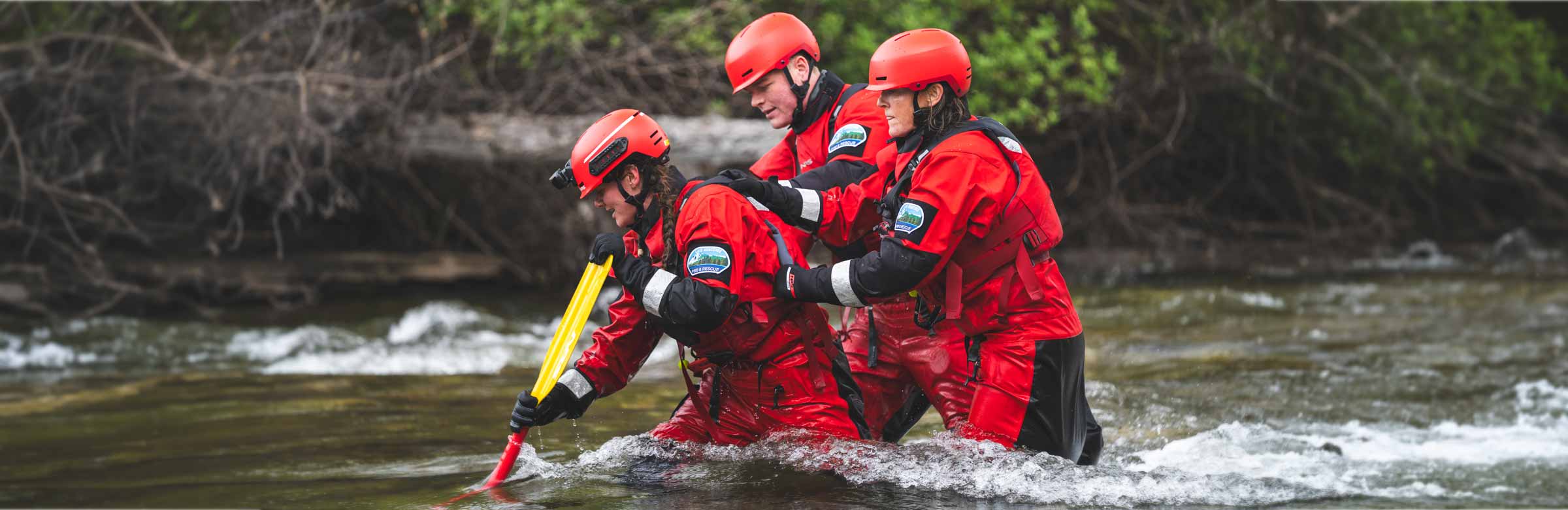
In this series, swiftwater rescue instructor Jim Coffey introduces techniques for assessing foot entrapment situations and formulating a plan to assist the victim.
What is Foot Entrapment?
Foot entrapment occurs when the foot of a swimmer or wader becomes lodged in rocks or other debris on the river bottom. You can’t clearly see what’s under the water: rocks, logs, and other obstacles can be waiting there to trap a dangling foot.
Due to your cookie choices, we cannot show you this content. Adjust your settings?
With foot entrapment, water pressure can make extracting the foot and freeing the victim difficult. The force of the current pushes the swimmer down, often holding their head underwater, leading to loss of airway and potentially drowning the swimmer. Wearing a PFD usually doesn’t save you—the force of the water can overwhelm that flotation. Never stand in water unless it’s very shallow or calm.
Saving someone in this situation is very difficult and rarely successful. You have only a very few minutes to reach a person whose head is underwater.
What to Do When Someone’s Foot Becomes Trapped
Most foot entrapments happen in waist-to-chest-deep water. In any scenario, you need to establish upstream safety to prevent any other groups from blundering into the rescue. You also need downstream safety to catch any rescuers who get swept away, or to catch the original victim.
Due to your cookie choices, we cannot show you this content. Adjust your settings?
The first thing we need to assess is the victim’s situation. Is their head up and do they have an airway? Or, are they face down with no airway? If they have an airway, you’ve got some time, but they need stabilization. If they don’t have an airway, they need immediate extraction. If face-down, but with an air pocket, it may be possible to hit them with a rope they can grab onto and stabilize their position.
The second assessment is whether you can make direct contact with the victim. Direct contact is the best way to help them. If we can’t do that, the hope of rescue really goes down. Always remember: a rescuer needs to assess the level of risk and avoid becoming a victim themselves.
Our third assessment is the location of the victim relative to the bank. If they’re within 60 feet (18 meters) of both banks, you can consider using techniques where you’re working from both banks. If we don’t have that, hopefully you’re within that distance from one bank.
These situations often require swift action to save a life. It’s very important that we’ve practiced these skills ahead of time, otherwise we’re wasting precious seconds figuring things out.
Again, assessment needs to be made of our skill level for the rescue, and an acceptable level of risk. Swiftwater rescue training and practice are necessary if these rescues are to be possible and successful.
How to Prevent Foot Entrapment
As with most accidents, prevention is the best solution. When you find yourself in the water, it’s usually best to assume the “swimming safety” position: on your back, with feet up and facing downstream. This allows you to look downstream and push off any rocks or other obstacles with your feet. You can backstroke at an angle to the current and work your way to shore or into an eddy. If the water is deep enough and you need to move more quickly, you can roll over on your stomach and swim aggressively to avoid danger or get to shore.
The basic rule is: never stand up or put your feet down in the water, unless the water depth is below your knees or the water is calm. Sometimes swimming is unavoidable. However, staying calm, working to self-rescue and remembering this basic rule can usually keep you out of trouble.
 NRS Gift Card: Always Fits, Always Wanted