How to Strap Kayaks to Your Car
Most kayaking adventures—whitewater, sea kayaking, or recreational touring—require a road trip. Safely loading kayaks on your vehicle’s roof rack is an important boater skill. In this article, we’ll walk through single-strap and multi-strap methods, using stackers, and when to add bow and stern lines for extra security. Failure to do it right can result in your boats flying off and getting damaged or causing an accident.
Article Contents:
How to Tie Down a Kayak With One Strap
The one-strap method is perfect if you have just one boat and one strap. You’ll need a long strap like a 15', or a 20' if you have a wider boat.
Due to your cookie choices, we cannot show you this content. Adjust your settings?
One Strap, One Boat
- Toss the buckle end over the boat.
- Wrap the strap around one of the rack bars in front of you.
- Thread it back to the other end of the boat.
- Wrap the strap around the other rack bar in front of you.
- Run the strap back over the boat.
- Thread the strap around the rack bar on the opposite side
- Run the strap back to the buckle end and secure it. Tie off excess strap so it doesn’t cause issues when driving.
Tip: If there’s a rescue loop on the boat, thread the strap through it before tightening it as an added precaution.
How to Secure Two Kayaks Using a Single Strap
If you have two boats and only one strap, place the first boat on the rack, right-side up, then place the second boat on top of it, upside-down. Thread the strap around the two boats and the rack like you did with the single boat.
Why and When to Use Multiple Straps to Secure a Kayak
Using two straps instead of one adds a critical margin of safety. Even when a single strap is routed around both crossbars, it still represents a single point of failure. A strap on each crossbar provides true backup if any one part of your system gives way unexpectedly.
Longer kayaks also benefit from being anchored at both bars, reducing the leverage that can cause a single strap to loosen as the boat flexes. And in sudden swerves, crosswinds, or hard braking, securing the boat at two points keeps it from twisting or shifting under load, ensuring the whole system stays tight when you need it most.
How to Use Two Straps to Tie Down Your Kayak or Canoe
If you have two 9' or 12' straps, use one on each end of the rack.
In short: run your strap under the first bar, over the boat, under the second bar, then back up to the buckle and snug it down.
Use Kayak Stackers to Secure Kayaks
Kayak stackers are vertical supports—typically a post or tall loop—that let you load boats on their sides for more efficient use of limited roof and rack space. Instead of resting kayaks hull-down or deck-down, the stackers give you a stable surface to stand them on edge and secure multiple boats side-by-side. Stackers are especially useful when you’re hauling multiple kayaks or mixing different boat sizes on a short rack.
If you have kayak stackers on your racks, first thread the strap through the stacker. Lean the boats against the stackers and tie them down using the same two-strap method detailed above.
If you have multiple boats and no stackers you can place a single boat, or two nested boats, on one side of the rack, and lean the other boats up on edge against them. Then use two straps to go over the whole load of boats.
Bow & Stern Lines
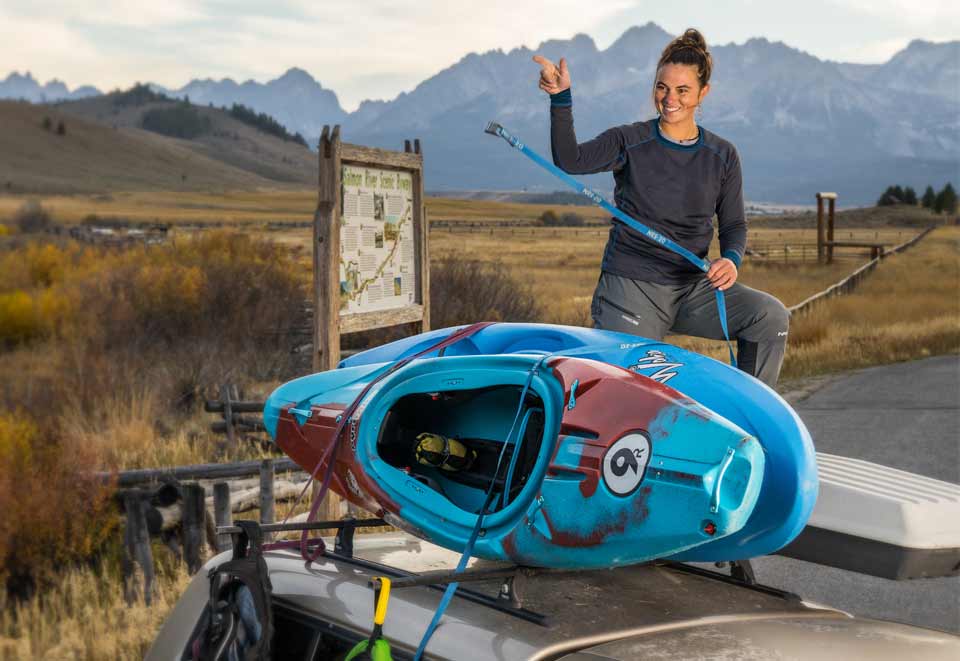
Bow and stern lines add an extra layer of security by anchoring the ends of the boat directly to the vehicle, not just the rack system. At highway speeds, a kayak can generate surprising uplift, especially in crosswinds or when passing large trucks, and that upward force transfers straight into the towers and bars. A properly tensioned bow line counters that lift, keeping the boat from tugging on the rack and reducing stress on the entire system.
These lines also matter in the moments you can’t predict—sudden braking, evasive maneuvers, or an accident. If the rack shifts or fails, the bow and stern lines act as a safety tether, keeping the boat from sliding forward or launching off the vehicle. It’s a small step that dramatically improves stability and peace of mind.
The NRS J-Hook Straps are specifically designed for this purpose. The rubber-coated hooks clip into boat grab loops or carry handles, as well as secure attachment points on your vehicle.
Other Tips, Tricks and Considerations
After years of hauling boats and fielding customer calls, we’ve seen the small details that make the biggest difference on the drive to the water. The tips below help prevent the most common problems we hear about and keep your rack system, your vehicle and your boats in good shape.
Put a Twist in the Strap
Anytime you’re using a tie-down strap on a vehicle where a section of the strap is not directly against something, put a twist in the strap in that area. This helps eliminate “strap strum,” the rhythmic vibration of the strap in the wind. Under the right conditions, this vibration can generate enough energy to actually melt and part a strap. This also helps cut down on noise.
Protect Your Vehicle From Buckles
Throwing straps around your vehicle can result in a dent—or broken glass—if the buckle gets away from you. Consider a few dedicated Buckle Bumper Straps for strapping your boats to your rack; the rubber guard adds bounce to the buckle to prevent unhappy accidents.
Don’t Over-Tighten
Your straps only need to be snug enough to keep the boat from shifting. Cranking down too hard can damage or crack composite hulls, distort plastic boats, or stress your rack system more than necessary. A firm, even tension is all you need; let the strap and the boat’s shape do the work, not brute force.
Don’t Use Your Car as a Storage Rack
Roof racks are built for transport, not long-term storage. Leaving your kayaks, canoes, or other boats strapped down for days or weeks can warp plastic hulls, prematurely age outfitting components, and expose your gear to unnecessary UV damage. Once you’re home, unload the boats and store them properly to preserve your gear.
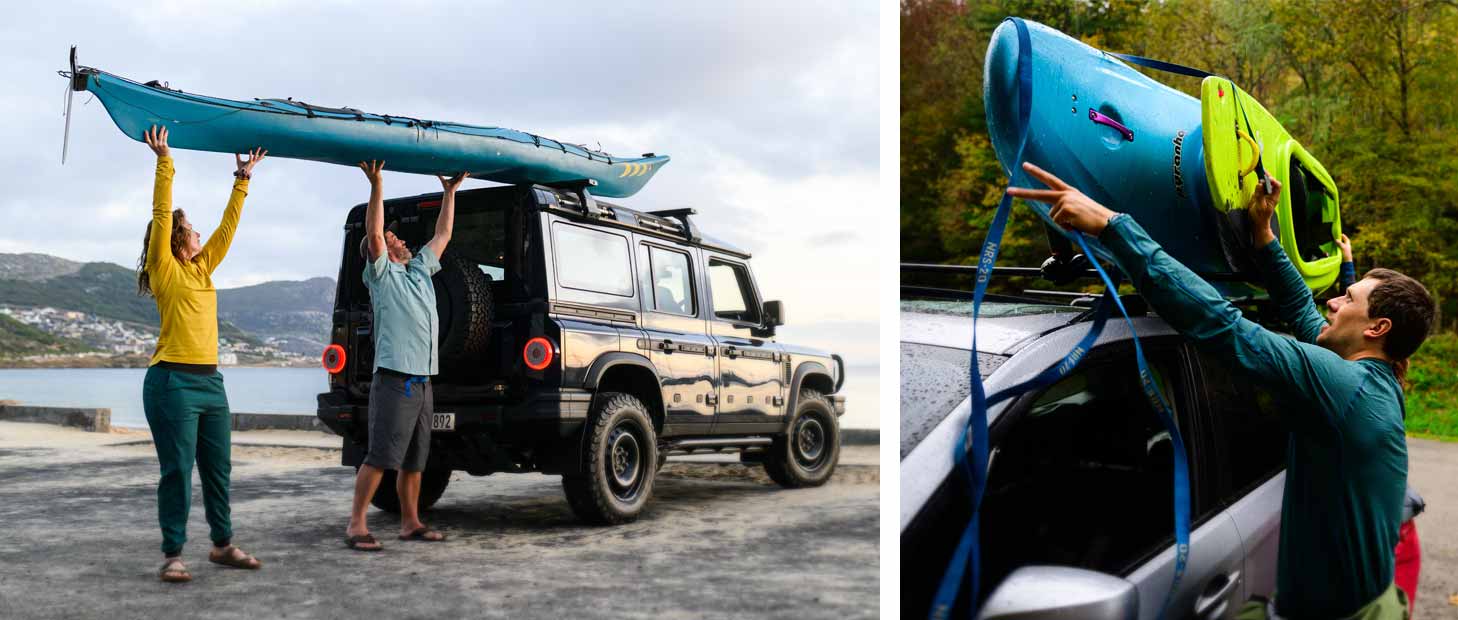
Following these simple steps will get you and your boats to the water with no hassle. Trust us—you don’t want to see your boat in the rearview mirror!
 NRS Gift Card: Always Fits, Always Wanted