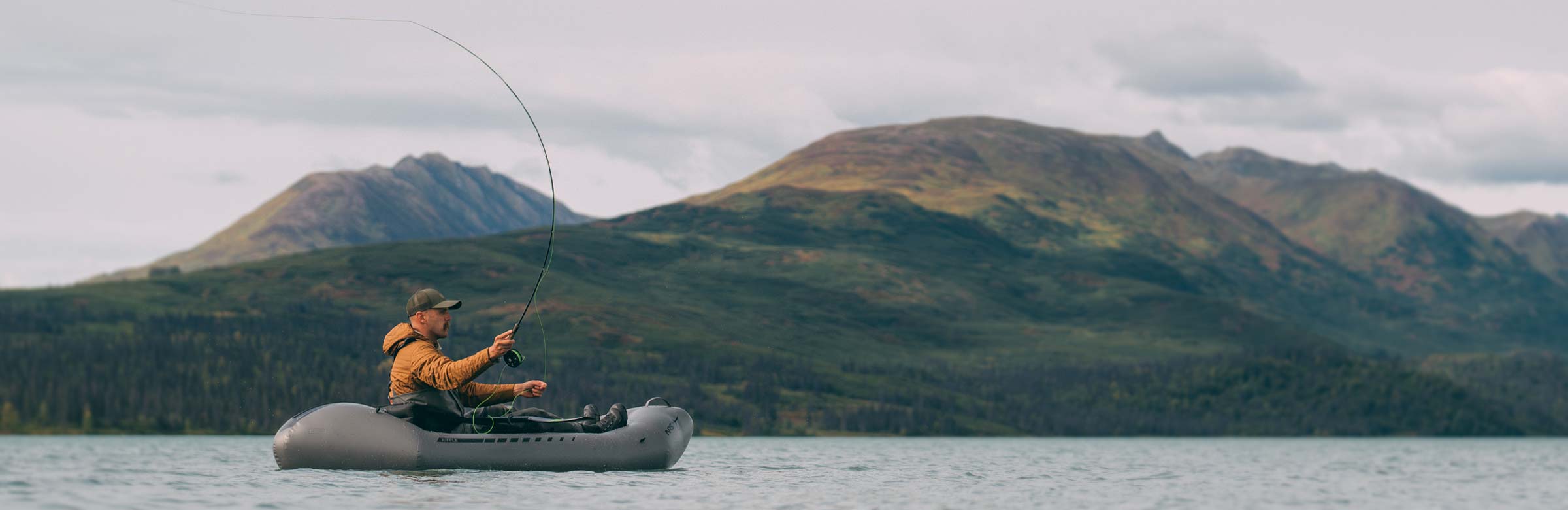
Ultimate Guide to Packraft Fishing
It’s no secret: fishing is fast becoming one of the most popular outdoor activities. More people than ever are spending their weekends tying flies, casting lines and enjoying the company of family and friends on the water. This boom in popularity also means that the rivers, lakes and streams where we cast are getting busy, encouraging adventurous anglers to seek out new, less-crowded waters.
By opening the door to remote areas not traditionally accessible to most anglers, the packraft has become one of the mightiest tools in the angler’s quiver. That opposite bank you’ve always had your eye on? The hidden alpine stream with no room to cast? How about that roadless river you know has an amazing hatch but no boat ramp? Queue: the packraft.
In this guide, we dive into the perks of fishing from a packraft, including what makes a packraft suitable for fishing, along with best practices, technique, safety tips and more.
Article Contents:
- What is Packrafting?
- Advantages of Packrafts Over Traditional Watercraft
- How Packrafts Enhance Fishing Opportunities
- Tactics and Target Species
- Packraft Fishing Strategy: Real-World Tips
- Safety First: What Every Packraft Angler Should Know
- Why the NRS Riffle is the Ultimate Packraft for Anglers
- Conclusion
What Is Packrafting?
At its core, a packraft is an inflatable boat purpose-built for backcountry travel. Normally intended for use by one or two people, these boats are ultra-light (often under 10 pounds), pack down to the size of a sleeping bag and are constructed with bomber materials like urethane-coated nylon and heat-welded seams to handle serious water and all that comes with it, from rocks to blackberry-filled banks.
But what separates a packraft from an inflatable kayak or a small raft isn’t just size—it’s purpose. Packrafts can easily be hiked into remote terrain, inflated on the bank and deployed in waters ranging from alpine lakes to technical rivers and everything in between. They’re stable enough for casting a fly rod, responsive enough to punch through current and durable enough to handle scrapes on shallow gravel bars without worry.
Advantages of Packrafts Over Traditional Watercraft
Traditional fishing watercraft—drift boats, catarafts, fishing kayaks—have limitations that experienced anglers know well. Most require put-ins, take-outs, trailers and sometimes even shuttles. They're great when you're working big water or spending a day out with the crew, but not when your destination lies beyond trailheads or across long portages. Packrafts excel in the exact places those boats can't go. Some common use cases are:
- Crossing a lake to fish a remote stream that never gets fished.
- Hiking four miles up a wilderness trail and then floating down a high-country stream, catching hungry trout in every pool along the way.
- Drifting a tight, brush-choked spring creek where casting from shore is impossible.
- Running a braided river system where channels split and reconnect unpredictably, demanding agility and shallow draft.
- Stealthy gear transport on a walk-and-wade adventure.
With a packraft, the approach is part of the pursuit—and so is the retreat. You can hike in, then float back to where you parked without the need for a shuttle. That’s handy, especially in remote places where shuttle services don't exist. Of course, you can always use a packraft anyway on trips where you do have a shuttle.
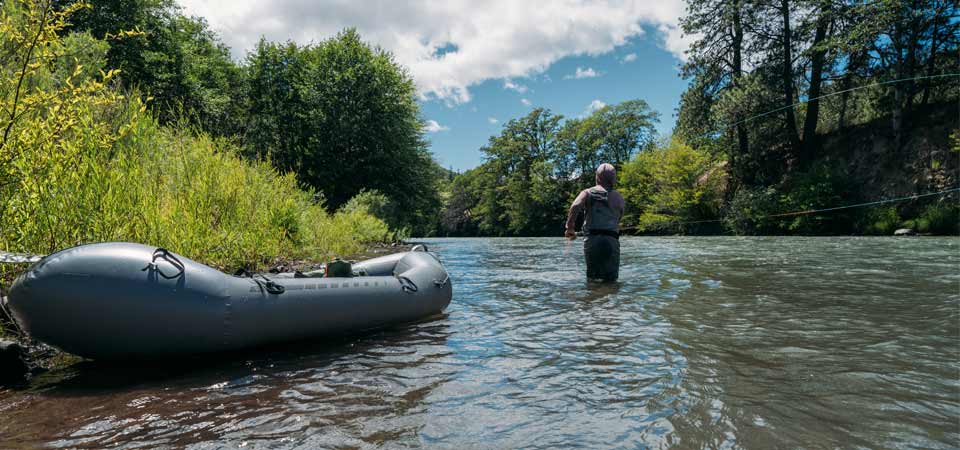
Fishing from a packraft gives you the chance to experience things most anglers can’t. Whether it’s as simple as fishing the far bank on your local river, or trekking through the high country for trophy trout on lakes that have never seen a raft, a packraft opens the door to unique fishing opportunities all over the world.
How Packrafts Enhance Fishing Opportunities
Anglers who integrate a packraft into their toolkit unlock an entirely different map of possibilities.
Remote Access
The entire backcountry is open for you to explore. Without the need for a trailer or boat ramp, you can fish lakes and rivers beyond the reach of conventional watercraft. Carry your packraft on your back and explore regions you’ve always dreamt about or run a section of an idyllic roadless river that’s been calling your name for years.
Escaping Fishing Pressure
Packrafts let you easily access the opposite bank or rotate to different spots on the lake, all while taking you away from highly-pressured, overfished access areas.
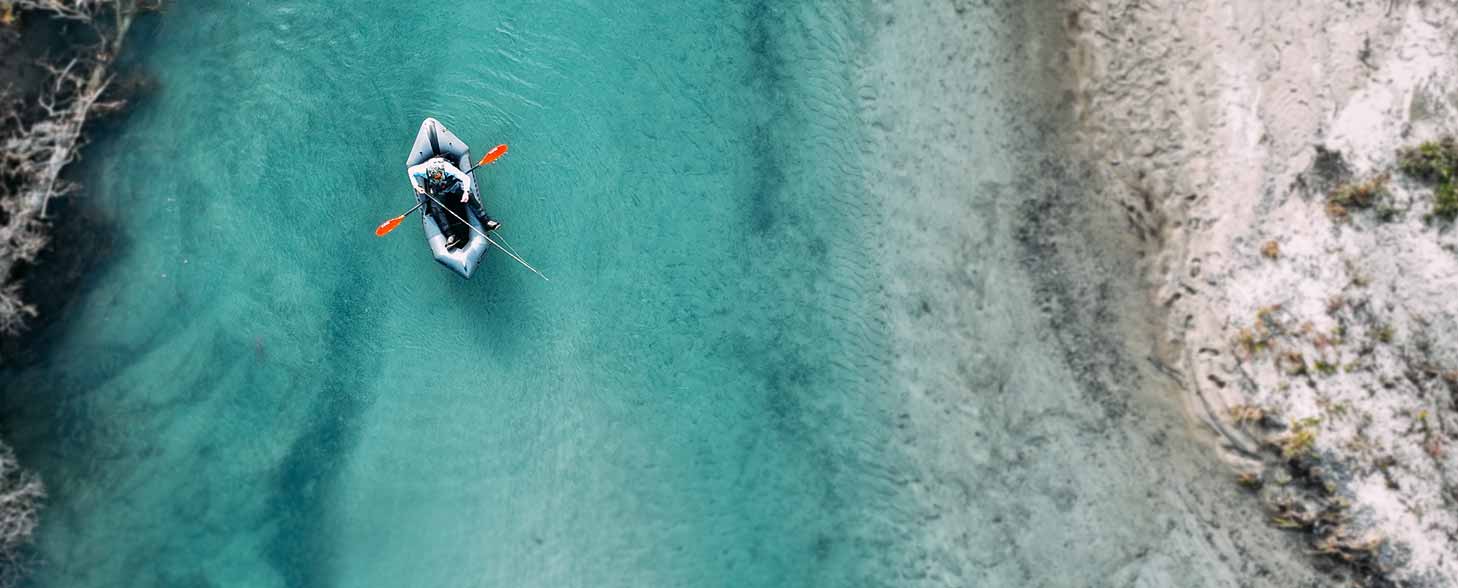
Combine Hiking and Fishing
Do a loop—up the ridge, down the drainage and float out. The lightweight and packable nature of packrafts means you can cover new areas and unlock new human-powered adventures. With a packraft and a few miles on your boots, the casting opportunities are endless.
Tactics and Target Species
Paddling and maneuvering a packraft is a bit different than traditional watercraft. You’ll want a solid grasp of the Sweep Stroke, Forward Stroke and Brace Stroke to make sure you’re paddling safely and efficiently.
The Sweep Stroke is used to turn the packraft, using a horizontal paddle angle and pushing or “sweeping” out in an arc from bow to stern to initiate your turn. The Forward Stroke keeps you going forward. You’ll want a shoulder-width grip on the paddle, recruiting your torso to ensure you get maximum power out of each stroke. A Brace Stroke keeps the packraft from capsizing. This is accomplished by keeping the paddle blade flat against the surface of the water and using your lower body to return your craft to a stable position.
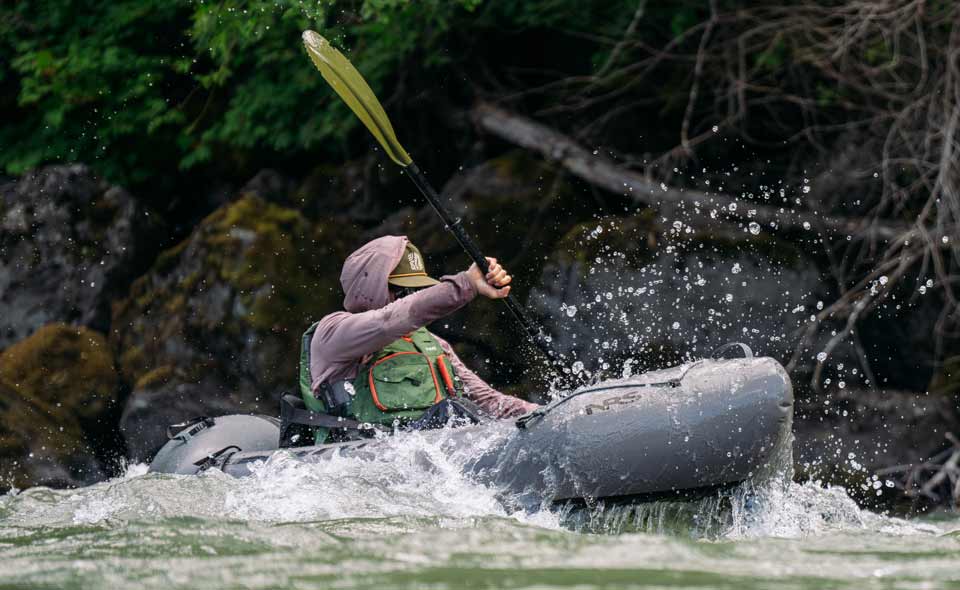
When you’re not paddling, you have various options for how you present your flies to the fish. One obvious benefit to the packraft is that you can position yourself directly over weed beds and drop-offs—places fish love to hang out. They’ll patrol these spots looking to ambush smaller fish or just to have an easy meal of the aquatic insects that are commonly found in these spots.
You can also use a packraft to troll streamers on a full-sink line. This can be effective on deep, high-mountain lakes with steep drop-offs. Again, fish patrol these drop-offs all day long, so a streamer right along that depth change, pulled at a consistent speed, can put quite a few fish in the net.
Packrafts give you the chance to target all sorts of fish, including:
- Trout: Perfect for high alpine and subalpine lakes, freestone streams and technical creeks.
- Smallmouth Bass: Great for floating rocky, mid-size rivers in the Midwest and East.
- Pike and Musky: Deadly combo in marshy, roadless lakes across the North.
- Dolly Varden & Arctic Grayling: Common in backcountry Alaska floats.
- Carp: In the right conditions, floating flats-style can be lethal.
Finally, remember that a packraft functions differently than a drift boat. While drift boats allow you to see tons of country and pass over a lot of water, it’s not always feasible to backrow up a run and fish it again. In a packraft, you can pull over and wade fish the spots that look too good for a single drift.
If you’re the type to keep your catch, packrafts have plenty of options to haul them back to camp or the truck. Options include:
- Soft coolers or insulated dry bags strapped to the bow.
- Mesh catch bags hung off the side.
Packraft Fishing Strategy: Real-World Tips
A great way to find new places to explore is by using an app like onWater Fish, which helps you plan a route, identify lakes and streams you’ve never fished before and give you a concrete idea of what to expect when you hit the water. You can also view private and public property boundaries and check conditions, which is especially helpful for planning trips.
Once you’ve made a plan, start prepping your gear and packraft. Since packrafts take up minimal space, a good waterproof backpack or duffel bag can store the packraft and your fishing gear for easy transport.
Once you arrive, it’s time to set up the packraft. The inflatable portion of packrafts typically has a zipper or hatch to access the internal tubes. This often doubles as dry storage, so anglers can store extra gear, a backpack or other essentials out of the way while keeping them dry. Fishing gear like your rod, reel and fly boxes should be kept out of the internal storage, as you will have to deflate the packraft to access this.
Safety First: What Every Packraft Angler Should Know
With packrafts, anglers face a unique set of hazards:
Water Levels
A Class I stream in May might be a flood-stage hazard in June. It’s important to check river flow gauges and snowpack data before heading out on a float. While packrafts are stable, they’re smaller than other rafts and drift boats. Be cognizant of flows, the capabilities of your packraft and your paddling ability.
Weather
Especially in the mountains, wind can turn a mellow float into an exhausting epic. When fishing, weather is always a concern; it’s best to check the radar before and change plans if needed. There’s no reason to get caught in a thunderstorm on the water when you can avoid it.
Gear
Always wear a PFD. A properly sized and secured life jacket is a must when packrafting, especially if you’re out there alone. This is especially important if you’re wearing waders. If you fall in and fill your waders up with water, it can be even more difficult to get back to safety. A PFD will help keep your head above water even with flooded waders and will aid in rescue situations. You should also carry a repair kit, emergency supplies and a satellite communicator.
Risk Management
It pays to be informed. Use the PaddleWays app to enhance your pre-trip recon by looking up weather conditions and river flows in advance. Check difficulty ratings for different sections, plot your exact route in river-miles and see other users’ comments for recent updates and condition reports.
Keep in mind that fishing can lull you into complacency. Don’t forget: you're still boating! Even flat or slow-moving water contains hazards. Scout blind corners, respect strainers (an obstruction like a tree that allows water to flow through but not a boat or person) and stay clear-headed for a safe day on the water.
Note: While packrafts are a great, beginner-friendly watercraft for those with limited paddling experience, consider taking classes with a local outfitter, including swiftwater rescue training, before attempting a larger or off-grid packraft fishing mission.
Why the NRS Riffle is the Ultimate Packraft for Anglers
The Riffle Packraft was purpose-built to solve the unique challenges of fishing from a packraft and open up new water for anglers. Fully rigged, it weighs in at just 12 pounds—more than light enough for hikes into remote rivers and lakes—and rolls down to be super compact (22" L x 18" W x 11.5" H). The combination of its lightweight, angler-focused design and wilderness-ready construction makes it perfect for the adventurous angler.
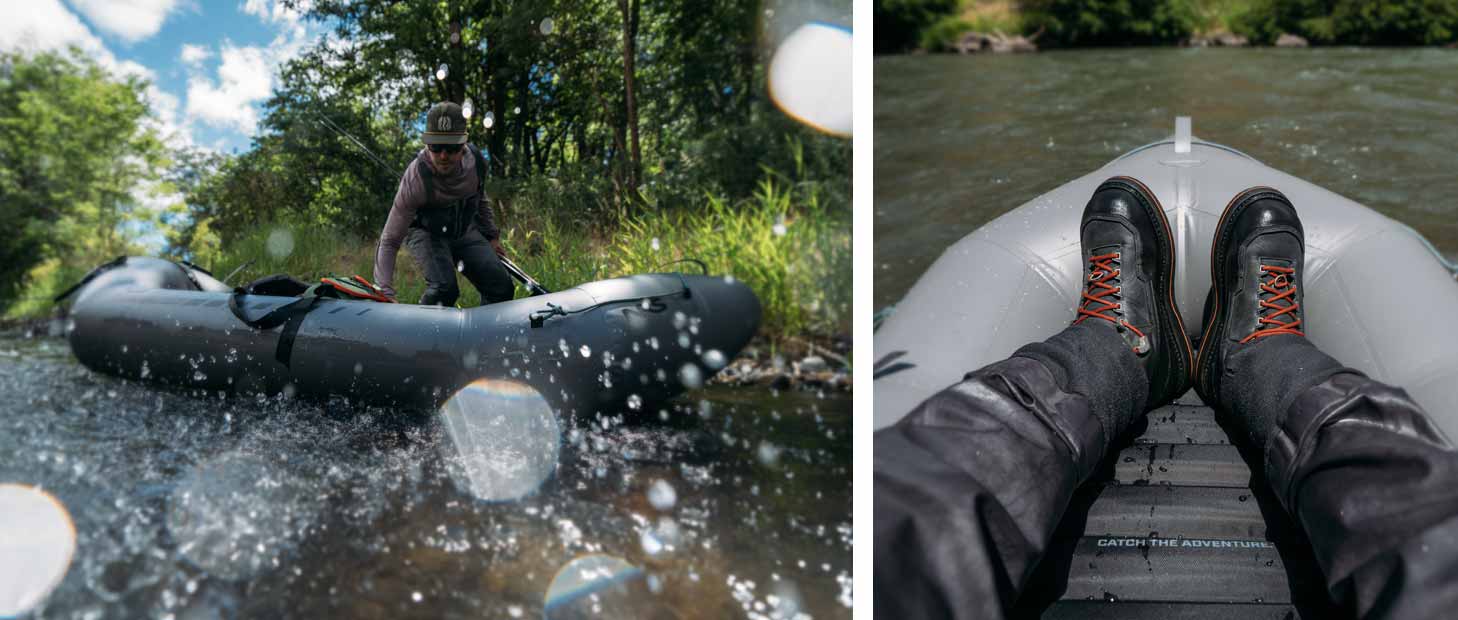
It’s constructed out of TPU-coated nylon for the same durable, reliable performance as any NRS raft. The underside is 840D nylon for added protection, while the tubes are 420D nylon, which allows for greater packability. Plus, every Riffle includes a repair kit for waterside repairs.
The Riffle is also packed with features tailored to anglers. Cut-outs on each side of the inflatable floor secure fully rigged rods. Nylon webbing loops in the bow and stern allow anglers to secure extra gear for custom setups or extended trips. And for even more storage space, the packraft itself moonlights as a dry bag thanks to its TIZIP® stern closure. This waterproof zipper gives anglers access to the inside of the raft for added dry storage when needed. Don’t forget to properly distribute the load!
Pro Tip: Try the NRS Packraft Internal Storage Bag to keep gear dry and balanced inside your tubes.
Conclusion
If you’re looking to escape the crowds and experience all-new fishing opportunities, a packraft might just be the ticket. These compact, easy-transport rafts open the door to exploring waters and landing fish in places others can’t. No trailer, no boat ramp, no problem!
With a packraft, it’s not a question of am I going fishing this weekend…
The question is: where?
 NRS Gift Card: Always Fits, Always Wanted