How RECCO Rescue Technology Works for Paddlers
For rafters, whitewater kayakers, and packrafters, search and rescue situations are often a race against time. Complicating factors such as remote paddling locations, difficult terrain, dynamic weather, and changing currents and water levels can all inhibit a professional search and rescue (SAR) team’s ability to quickly locate a missing paddler. SAR teams must use every tool at their disposal to speed up the search.
One tool that’s being increasingly adopted in outdoor gear is RECCO® rescue technology. Originally developed for the ski industry to help with avalanche rescue, RECCO is now being integrated into apparel and equipment across other outdoor sports, including paddlesports such as kayaking, rafting, and packrafting.
But what is RECCO, exactly? How does it work? And what role can it realistically play in the world of paddlesports?
In this Article:
What is RECCO Technology?
RECCO rescue technology is a passive search-and-rescue system that helps professional rescuers locate missing people in outdoor environments using radar detectors and integrated reflectors.
Due to your cookie choices, we cannot show you this content. Adjust your settings?
RECCO technology is designed to help professional SAR teams locate missing people in outdoor environments, such as a whitewater kayaker in a steep river valley. The system consists of two components: a small, passive reflector integrated into gear or apparel, and a handheld (or helicopter-mounted) detector operated by professional rescuers.
Unlike satellite locators, GPS devices, and cell phones, RECCO reflectors don’t transmit a location signal on their own. They are truly passive, meaning they don’t require any kind of power; you don’t have to charge them, fuss with batteries, or worry about turning them on and off. Instead, reflectors simply respond to a radar signal emitted by a detector.
How RECCO Rescue Technology Works
RECCO is a two-part system that consists of a reflector (worn by a paddler) and a detector (operated by a professional rescuer).
- The reflector is a lightweight, passive transponder that does not require power or activation to function. Its simple construction consists of a diode and an antenna, and is typically integrated into an existing piece of safety equipment, such as a life jacket. Because they do not require power or batteries to function, reflectors are robust and can last indefinitely.
- The detector is a handheld unit operated by a rescuer that emits a directional radar signal (think: a flashlight casting a beam of light). When the radar signal hits the reflector, that signal is echoed back to the detector and points the rescuer in the direction of the paddler. As the rescuer moves closer, the signal becomes stronger, thereby allowing the rescuer to pinpoint the paddler’s location.
Detectors can also be used with SAR helicopters to cover a wider range than handheld detectors are capable of. These helicopter-mounted detectors transmit an omnidirectional signal, enabling rescuers to search about one square kilometer every six minutes.
Here’s another way to look at it: Think about how a standard reflector works on a bicycle or vehicle. When you shine a light on that reflector, that light is reflected back at you, helping you to see that bicycle or vehicle more easily. RECCO works similarly, but instead of using visible light, it’s using a radar signal that can cover long distances and is effective whether it’s day or night.
Benefits of RECCO Rescue Technology for Kayaking and Rafting
The nature of paddlesports can present a unique set of challenges when it comes to rescue situations.
Paddlers are often in remote locations with limited access points, making it challenging for rescue teams to reach their target. Unlike roadside emergencies, many paddling incidents happen far from the convenience of boat ramps and other traditional put-in and take-out sites. In some cases, SAR teams may need to search long stretches of difficult terrain—in potentially challenging conditions—before they’re able to locate the person in need.
It’s also not uncommon to have little to no cell service, which severely limits communications with rescue teams and other groups who might be in the area. And rivers can present a tricky combination of fast current, steep canyon walls, cold water, wood debris, and other factors that complicate an already time-sensitive operation.
But it’s not just backcountry and wilderness paddling where RECCO can come in handy. Other common paddling situations where RECCO may help include:
- Whitewater rafting and kayaking expeditions
- Remote multiday river trips
- Coastal kayaking
- Canyon whitewater kayaking
- Multi-sport packrafting trips
For any rafter, kayaker, or packrafter looking to venture beyond the roadside, especially where helicopter-assisted search and rescue could be a factor in an emergency situation, RECCO can provide an added layer of searchability without requiring extra maintenance or setup.
Bringing RECCO Technology to Paddling Gear
NRS was the first company to bring RECCO technology to the paddlesports market with the Vector Rescue PFD. Integrated reflectors on both the front and back of the life jacket may help professional SAR teams locate paddlers faster in an emergency situation.
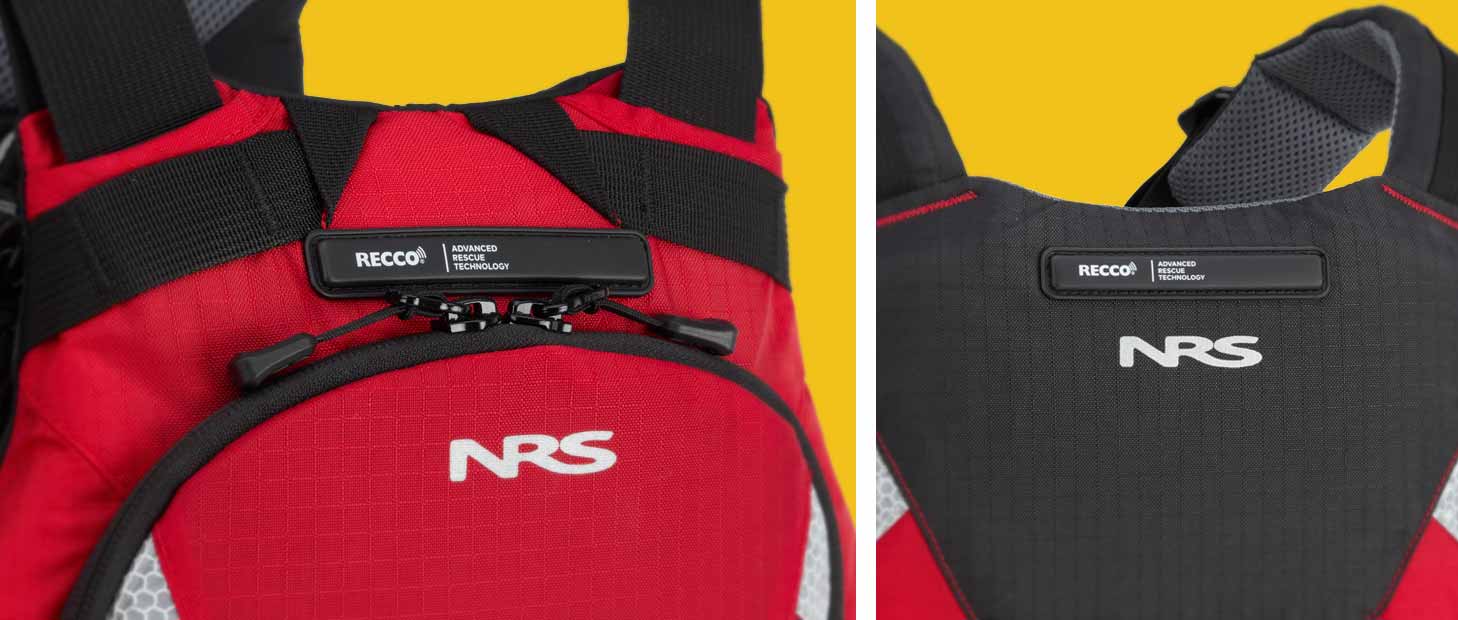
The inclusion of RECCO technology in the Vector PFD reflects a broader shift in outdoor safety equipment. Increasingly, gear manufacturers like NRS are exploring ways to integrate passive rescue tools directly into the equipment paddlers already rely on.
The unfortunate reality of whitewater paddling is that incidents requiring rescue do occur. As a community, we prepare for this with proper safety equipment and the training needed to utilize that equipment. The addition of RECCO reflectors to the NRS Vector PFD is yet another tool to support paddlers when professional search and rescue operators are called upon.
For expedition paddlers and whitewater boaters traveling in remote terrain, maintenance-free technologies like RECCO can be especially appealing. Unlike battery-powered devices, passive reflectors remain functional without needing to worry about charging schedules, signal subscriptions, or a potential in-field malfunction. That simplicity is part of what makes RECCO unique.
RECCO vs. GPS, PLBs and Satellite Communicators
As RECCO technology becomes more prevalent in the world of paddlesports, it’s important to understand its limitations.
RECCO is not a:
- GPS tracker
- Satellite communicator
- Personal locator beacon (PLB)
- Two-way messaging device
- Replacement for real rescue training
- Substitute for proper trip planning and safety equipment
A RECCO reflector cannot initiate a rescue response or broadcast your location to emergency services. It only works when trained rescuers equipped with a detector are actively searching for you.
It’s also worth noting that RECCO detectors are specialized devices operated solely by professional SAR teams. Private boaters, paddling clubs, and hobbyists are not able to purchase a detector for personal use.
RECCO Technology and Paddling Safety
It’s important to remember that being safe on the water is a multi-layered system: proper equipment, safety training, sound judgment, effective communication tools, and emergency planning are all key components in paddling safety. RECCO technology is best used as an additional layer to that system, and is not meant to replace or act as a substitute for established safety protocol.
Instead, RECCO is one more tool that professional rescuers can utilize to accelerate the search for missing paddlers.
 NRS Gift Card: Always Fits, Always Wanted